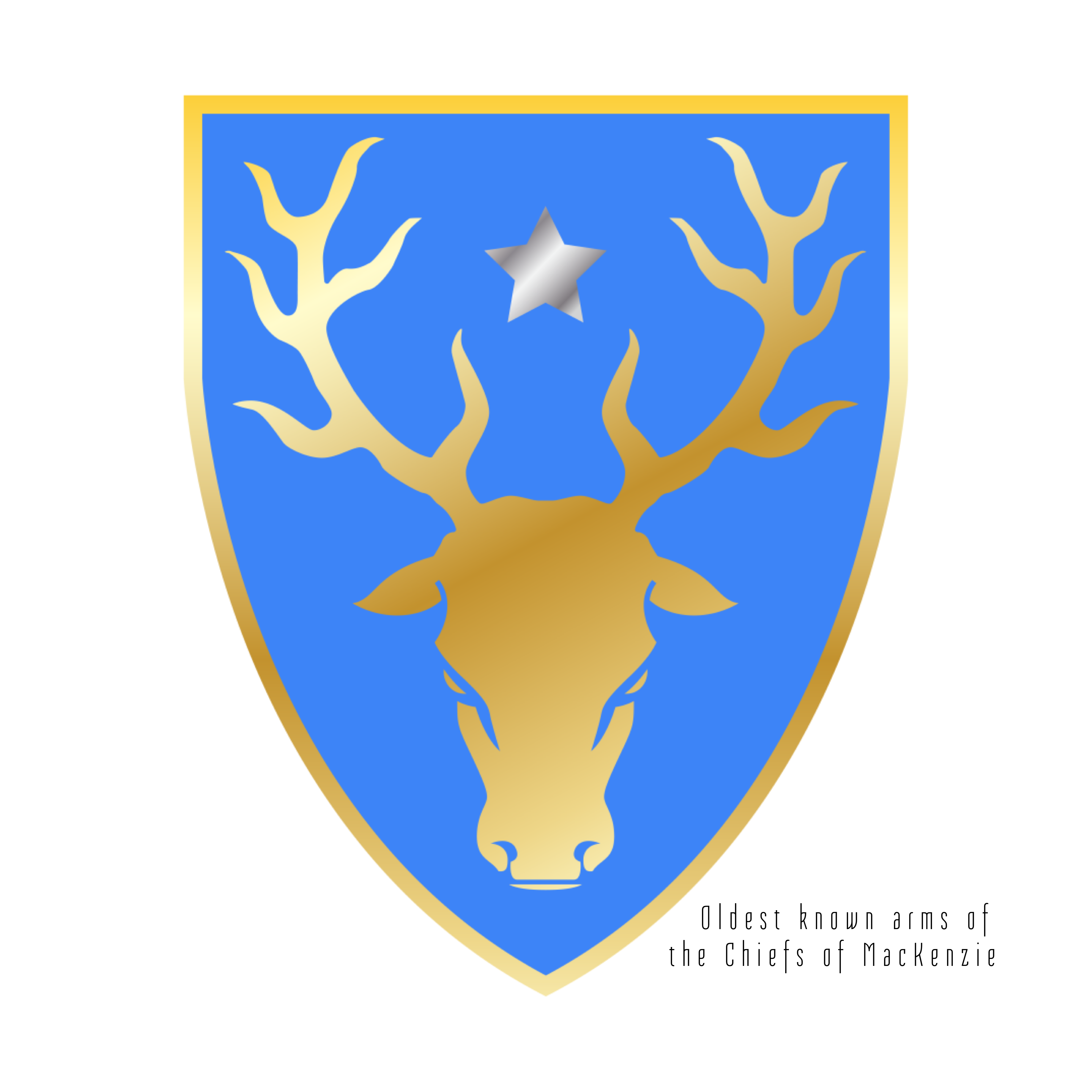
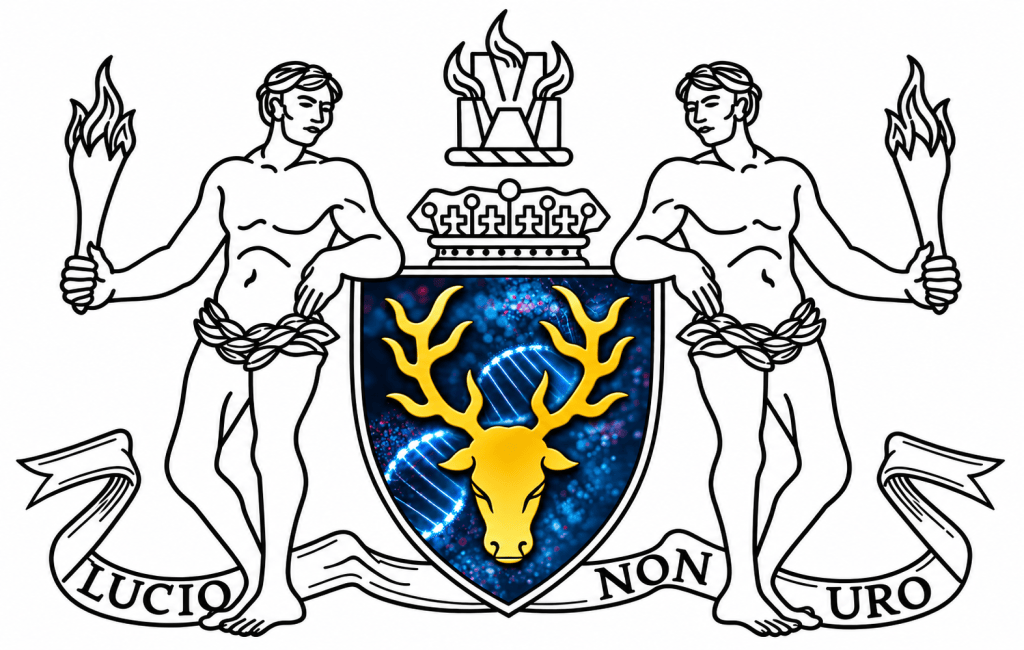
In May we be Britons? (2012) a reference was made to prevailing DNA evidence as corroboration of certain aspects of Mackenzie clan origins, based on the then prevailing (and ever-shifting) state of the science of DNA at that particular time.
Some clan societies have already been quick to revise traditional accounts based on interpretations of modern DNA research, raising questions about whether such changes are historically justified or premature.
However, the authors, and the Clan Mackenzie Initiative, have since come to the conclusion that surname DNA projects can say nothing useful, by way of either corroboration or disproof, about genealogical origins in such an early timeframe. Surname DNA projects are not pure science, as is often misguidedly assumed, as they involve subjective matching between DNA and genealogy, and absent extensive archaeological evidence through testing of human remains of identifiable individuals in a genetic or genealogical line from the time period in question (in the Mackenzie case, the 13th to 15th century, and before) they are inherently unable to pinpoint where one or more non-paternal events might or might not have occurred. With the Mackenzie “core group” identified by a Mackenzie clan surname DNA project, there was no pure, unadulterated science, as to identify it and describe it as such it involved identifying and matching DNA with known, reliable genealogical paper trails – and solely back to the 15th century. Because of reliable genealogies and paper trails back to that point, it worked well for the later period, but cannot do so before that.
For instance, it has recently been claimed on a Mackenzie clan surname DNA project website that the DNA evidence contradicts the “ancient tradition” of the Mathesons. There is, however, no such “ancient” tradition. The Matheson genealogy of modern Mathesons (Lochalsh, Shiness etc) was linked to that of the MacMathans of the early 15th century and before of MS 1467 (tied in it to the then living Mackenzies, and hence with the early MacMathans solely being relevant to the origins question) purely by genealogical speculation in the 19th century. Furthermore, aside from their latter Matheson genealogy being extremely speculative, it is not possible to pinpoint where a non-paternal event (or any of these) might or might not have occurred before the period of when the Mackenzie “core group” was generated, and/or before (or within) the periods when the Matheson cadet lines were generated (which was at the earliest in the 15th century, and on some accounts as late as the 17th century).
One of these claims to the effect that DNA evidence is somehow at odds with “ancient tradition” of the Mathesons has very recently been amended to state that there is no DNA connection between “the Mackenzie chiefly line” and the current Matheson of Lochalsh chiefly line or the Matheson of Shiness chieftain’s line. Without more, some may read this as still casting doubt on the connection between the Mackenzie chiefly line and the mediaeval MacMathans (because many might still believe that the latter were genetically synonymous with the modern-day Mathesons). The MacMathan connection is analysed in detail in published work on Mackenzie origins (including in particular MS 1467), such as that contained most comprehensively in “May we be Britons?” (2012), but also elsewhere.
It is very far from clear why Mackenzie DNA news announcements focus on the question specifically of whether the modern-day Mathesons are connected to the Mackenzie chiefly line, if one is not thereby trying to say something more than can actually be said on the Mackenzie origins question, on the current DNA evidence. To be clear, the current DNA evidence in fact casts no doubt whatsoever on the Mackenzie chiefly line/MacMathan link made in MS 1467, given the already long-known break in Matheson genealogy. Because of the latter, there has never been any reliable genealogical connection between the modern-day “Mathesons” and the (Mackenzie-connected) “MacMathans” of MS 1467, anyway. And as we say, this is doubly so, given the possibility of non-paternal events at any point in time before the 15th century, in the case of the Mackenzies, as well as before the 15th to 17th centuries in the case of the Mathesons.
For these reasons, some clan surname DNA projects appear sometimes to be overreaching themselves and attempting to do something that it is inherently impossible for them to achieve – namely to disprove or corroborate certain questions of clan origins. In the deep timeframe, before the modern period, postulated structures become a house of cards, as they involve subjective interpretation and absent archaeological remains, and expert statisticians coupled with computer-modelling on a vast, currently unavailable scale. For reliability requires modelling which takes account of all possible known and unknown variables, to pin-point in time specific possible non-paternal events and genetic mutations, and to fix precisely where these might have occurred. In a postulated structure, one error can infect another, and potentially throw a whole structure out of kilter. The y-line (seamless male genetic line), as Professor Brian Sykes noted, has a tendency to clustering and extinction, and this severely compounds the problems. All of this, no doubt, is why the question of DNA and origins of particular ethnic or genetic groups has, from inception, been very much a moving feast, and will no doubt continue to remain so – and as a very controversial one at that.
We take this opportunity to stress that the Clan Mackenzie Initiative regards the description which has sometimes been used (albeit a useful handle when describing particular DNA signatures) of a particular DNA signature as “Mackenzie core group” as (and this has been no doubt unintendedly) contrary to the spirit of clan Mackenzie inclusiveness, and risks being very divisive. Colin Mackenzie, Viscount Tarbat, son of our clan chief, in our recent podcast, rightly emphasised the importance of inclusivity. And as noted above, who is to say that individuals or groups outside the “core group” might not possess the y-line DNA of historical Mackenzies at an earlier point in time. That for instance, might be before the current chiefly and cadet lines formed. The latter was only mostly from the 15th century onwards, and certainly encompasses all of the individuals whose genealogy has been used to describe it as such. Nomenclature sometimes can be unintendedly dangerous, as it also risks an appearance of misogyny, diminishing as it might be seen to do the crucial contribution to clan history of women. Women (heiresses in particular, when it comes specifically to the transmission of landholdings and chiefly lines) played and continue to play a very important part in clan culture and history, and notably our own chief is descended in the female line. The inability of DNA testing, in a genealogical-historical context, to deal with anything other than seamless male lines (y-lines) risks unintendedly creating a contrary impression when used to seek to prove or disprove our Mackenzie clan ancestry and origins.
For those who are keen to know further background to all of this:
As was noted in “May we be Britons?” back in 2012, it was in 1836 that the distinguished historian, lawyer and antiquary, Dr William Forbes Skene, first asserted the Celtic origins of the Scots in general in his “The Highlanders of Scotland”.
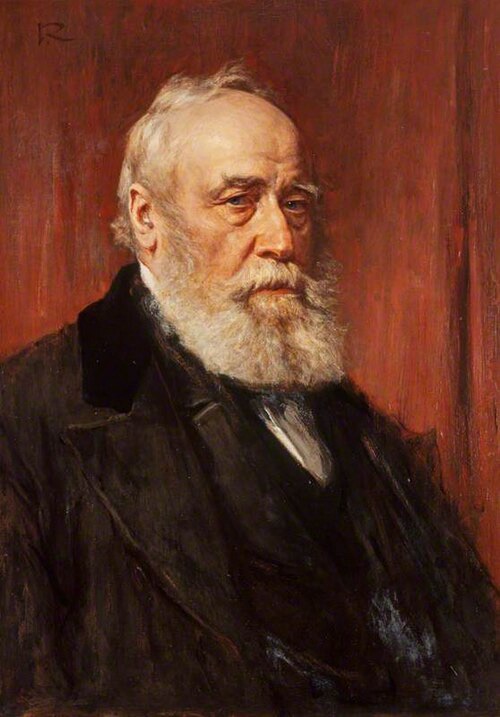
Thanks to Skene, most historians and genealogists have, ever since, accepted that a large part of the national identity of the Scots springs from an early Gaelic root that flourished in Ireland. Of course, that says nothing (and nor did Skene intend it to say anything) about the inevitable mingling of ethnicities and genetic lines (Pictish, Norse, Gaelic, Norman French and other – in the case of the modern-day indigenous Scots in particular). The mingling of genetic lines is clearly omnipresent in any nation, and in modern times is unquestioned outside Nazi ideology or the bigoted or uneducated world of ultra-nationalist, racist, or white supremacist agenda.
To what extent these genealogies involve a seamless male line, or include some intervening female lines or not, is, in the sphere of a scholarly historical, clan origins debate, very much an academic irrelevance too.
This at least is outside the very specific and wholly legitimate field of identifying genetic y-lines (which for the reasons we have already given must inevitably be divorced from research into historical clan identity and its origins) – or outside the narrow (largely old-fashioned) question of male-line primogeniture and particular legal family successions.
The latter is certainly no longer of any relevance whatever to the Mackenzies, as for them those were questions which were finally and very firmly put to bed once and for all in 1979, when the Mackenzie chiefship, correctly and legally, came out of its longstanding abeyance (which had existed between from the death of Francis, Lord Seaforth in 1815 right up until then).
“May we be Britons?” also highlighted very compelling historical corroborations (statistically highly improbable if they were purely a random concatenation of coincidences) of the traditional account as given by Sir George Mackenzie, 1st Earl of Cromartie (and ancestor of our clan chief). These corroborations of a female-line descent and significant early Mackenzie heraldic and cultural inheritance through the Fitzgeralds, as Kevin and Andrew have noted, entirely vindicate the 1st Earl from the oft-repeated, very unfair accusation of “pedigree-faking”. Indeed, the Earl was a scholarly man (an early member of the Royal Society and friend of Sir Robert Boyle and Sir Isaac Newton) and an accomplished lawyer, who as such would have been well-trained and experienced in assessing evidence. He preserved for posterity much obscure information regarding the clan’s origins which would otherwise have been lost and long forgotten.
And it has been rightly highlighted by many scholars that a close analysis of the earliest Mackenzie pedigrees, such as MS 1467, support Skene’s account, and explain how on close analysis apparent discrepancies in it can readily be explained and reconciled.
Just one corroboration amongst very many is the ancient Mackenzie oral tradition (the founding legend of Eilean Donan Castle), “the Legend of the Birds”
Aside from scholarly research and analysis, here is a wonderful, recently published artistic version of the legend:
It involves some poetic licence (such as calling the protagonist in the story the 15th-century Mackenzie progenitor Alasdair Ionraic – Alexander “the Upright” – rather than his 13th-century ancestor, Kenneth MacMathan), but, topically, is an illustration of how AI, despite its very many shortcomings, can sometimes now be used to bring old stories and legends to a younger generation, outside the somewhat dry world of pure academia.
As well as oral tradition, specific corroboration of MS 1467 also exists in the form of a document dating from c 1700, known as the MacMhuirich (or MacVurich) Manuscript, and, independently again, in the Senchus Fer n-Alban, or “History of the Men of Scotland” – a medieval Irish text believed to have been compiled in the 10th century, and which was possibly derived from earlier, Latin documents of the 7th century.
And both the work of the MacMillans conducted by the current Mackenzie clan genealogist (and seannachie to our chief), Graeme Mackenzie, and John Bannerman’s examination of the MacKinnons, support Skene’s earlier findings in this respect, with regard to a number of other clans.
Kenneth MacMathan, the man which all of this gives as the Mackenzie’s 13th-century progenitor – he was evidently the origin of the clan surname which originated as the patronymic “son of Kenneth” (the anglicised Coinneach) – was noted by the historian William Matheson in the 20th century as on the historical record no less than twice, at dates which the number of generations in the MS 1467 pedigree would lead us to expect:
Kenneth’s exploits against the Norsemen in the summer of 1262 are described in the 14th-century Icelandic “The Saga of King Haakon IV” (also known as the Codex Frisianus), where he is called Kiarnakr son Machamals (Kiarnakr represents the Gaelic Coinneach); and two years later we find Coinneach, or Kermac, mac Mathghamhna being rewarded for his services against the Norsemen. (This has been further discussed in our two-part article regarding “The Legend of the Bird’s – namely “The Raven’s Son”.)
Kevin also spotted that the precise relationship between the MacMathans (aka early Mathesons) and the Mackenzies may be explained by reconciling the respective early pedigrees in MS 1467 with the MacMhuirich MS.
For the name given for the father of Coinneach (i.e. Kenneth) in MS 1467 is Mathan (and hence Coinneach is “mac Mathghamhna”). This is generally thought to have been derived from the Gaelic word for bear, and supposedly due to a bear cult.
Historical accounts from the Roman occupation of Britain (up to CE 410) record that wild “Caledonian bears” were captured from the Scottish wilderness and transported to Rome to be used in gladiatorial arena games.
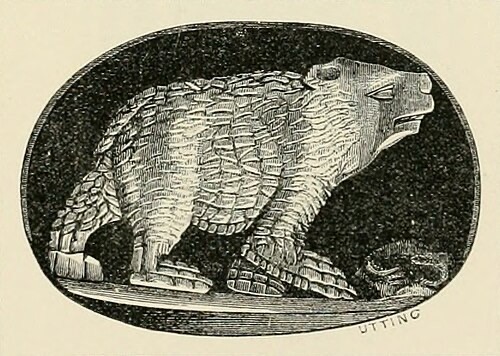
The native Picts of northern and eastern Scotland carved distinct, recognisable images of bears onto standing stones as late as the 8th and 9th centuries. This strongly implies that bears still lived in the regional ecosystem—or at least remained a vivid part of the immediate cultural memory—well into the Dark Ages. And many ecologists point to the dense forests of the Cairngorms and the remote glens of the Highlands as the final strongholds where the last remaining pockets of isolated wild bears would have made their last stand before completely vanishing by the High Middle Ages. So this would have been well within the memory of people who gave Kenneth’s father the nickname Mathan.
In MS 1467, Kenneth’s father is given as Angus “Crom” son of “Cristin” – who is also named as an immediate ancestor of Mathan in the MacMathan (aka early Mathesons) pedigree of the manuscript. “Cristin” is also given as father of Kenneth in the MacMhuirich MS, and he was a proven historical person on record as “Gilchrist filius Kinedi” in 1222, as a claimant to the Scottish Crown.
In “May we be Britons?” all discrepancies between these early pedigrees were analysed in considerable depth, and readily reconciled, as yet further corroborative evidence of the Mackenzie line (anachronistically nowadays styled “chiefly line) of MS 1467’s immediate descent from a branch of the merged Dalriadic-Pictish Scots royal house at this time. “Cristin” was no doubt another patronymic/dynastic appellation, and few of these names should be treated as akin to forenames or Christian names in a modern-day sense. To treat them as such, and regard these names as somehow giving rise to discrepancies between early manuscripts, would be wholly anachronistic.
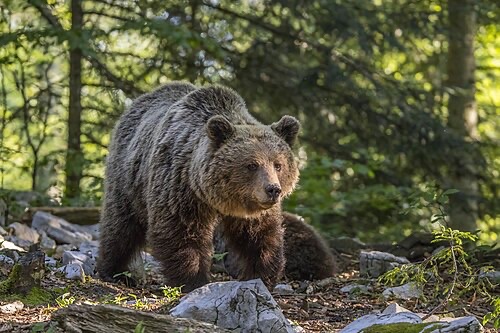
Highly significantly, Kevin’s detective work long ago spotted that the word “Crom” is Gaelic for “humpbacked” or “hunchbacked”. And the Eurasian brown bear has a very visible hump. So, a nickname at the time for a hunchback would inevitably have been “the bear”. As Kevin noted in his research for “May we be Britons?”, it would be entirely consistent – indeed very likely indeed, therefore – for the Angus “Crom” and “Mathan” of these pedigrees to have been one and the same.
This would thus make make Murdoch of MS 1467, son of Kenneth (son of “Mathan”) the progenitor of the medieval MacMathans’ male line (aka early Mathesons) as given in the medieval MacMathans’ (aka early Mathesons’) part of the pedigrees one and the same as John of MS 1467, son of Kenneth (son of Angus “Crom”), the progenitor of the medieval Mackenzie male line as given in the Mackenzie part of these pedigrees.
So far, so good. However, what of the sudden very recent claims based on DNA test results that there is somehow a “contradiction” between what’s been labelled “Mackenzie core group” and Matheson y-line DNA signatures?
If this alleged discovery of a “contradiction” – as has, sadly (it seems under internal pressure), unknowingly been repeated very recently across a number of Mackenzie clan society websites, is intended to say anything about Mackenzie and Matheson origins, it does no such thing.
For the Mackenzie “core group” is only defined by matching against a genealogical paper trail back to Alastair Ionraic (Alexander “the Upright”), the 15th-century Mackenzie progenitor of the cadet lines which encompass all of the tested individuals of the Mackenzie “core group”. It says nothing about what the y-line signature or signatures of individuals within Alexander’s paternal line was/were, or what the y-lines of the modern (i.e. post-15th century) Mathesons was/were before at best c 1500, and at worst the 17th century.
The well-known Stirnet surnames genealogical site has, in any event, long very publicly emphasised that a connection between the Matheson chiefs and their cadet lines with the MacMathans of MS 1467 is at best highly tenuous and at worst non-existent. So this can in no way be presented as in some way a new discovery, based on DNA test results.
Indeed, all of this was picked up in genealogical terms as long ago as the 19th century by Alexander Mackenzie, the very well-known mutual Mackenzie and Matheson genealogical historian. His findings were published in 1900 in his “History of the Mathesons” – hence well over a hundred years ago now.
They emphasise that it is not clear how Murdoch, the individual listed as living most recent in time in the MacMathan part of MS 1467 is, if at all, related to the later, “Matheson” chiefly line of Lochalsh and its cadet branches (such as those of Sutherland including Shiness).
The 1863 edition of Burke’s Landed Gentry identifies John Matheson of Lochalsh (d 1537), brother of Donald Bain, as “eldest son of Alister MacRuarie, and tenth in descent from Mathgamma”. It does so by making a speculative leap in identifying John as “eldest son of Alister MacRuarie, and tenth in descent from Mathgamma”. Alexander Mackenzie the 19th-century clan historian, however, at page 8 of his “History of the Mathesons” reported a source which identifies Alastair MacRuarie as the same person as Alexander (or Allaster) MacGorrie, son of Godfrey of Garmoran. And he identified Alastair’s wife as a daughter of the laird of Mackintosh, the famous Malcolm Beg. Furthermore, Malcolm had no son-in-law of the name Alastair MacRuarie, nor of the name Matheson. (Instead, Alastair seems to have married an unknown lady whose second husband was Angus MacLeod of Assynt.)
So, Alexander Mackenzie had already, by 1900, cast huge doubt on the male-line ancestry of the Matheson chiefly line and its cadets – encompassing inevitably therefore the overwhelming proportion of the individuals now bearing the surname Matheson, and whose y-line DNA signatures have now been sought to be compared against that of the Mackenzie “core group”.
There has therefore never been any reliable seamless male-line link between the modern-day Mathesons, genealogically, genetically or otherwise, with the Mackenzie-connected MacMathans of MS 1467 and the ancient MacKenzie oral tradition.
It follows that it is axiomatic that DNA testing cannot possibly shed any light on Mackenzie clan origins – whether that be one way, or the other – other than in the extremely narrow sense of the scientific particulars of the y-line genetic ancestry of what happens since c 1500 to be one particular y-line, divorced therefore as that is from any meaningful medieval or earlier genealogical-historical context.
This article has been written by the Initiative with the kind historical research contribution of Kevin McKenzie, co-researcher with Andrew McKenzie of “May we be Britons?” (2012).
