Another Historical Example of the Star Between the Antlers

One of the most persistent misconceptions in modern Mackenzie heraldic discussions is that the star between the antlers is a recent addition to the Mackenzie arms. As we have previously demonstrated, the historical record tells a different story.
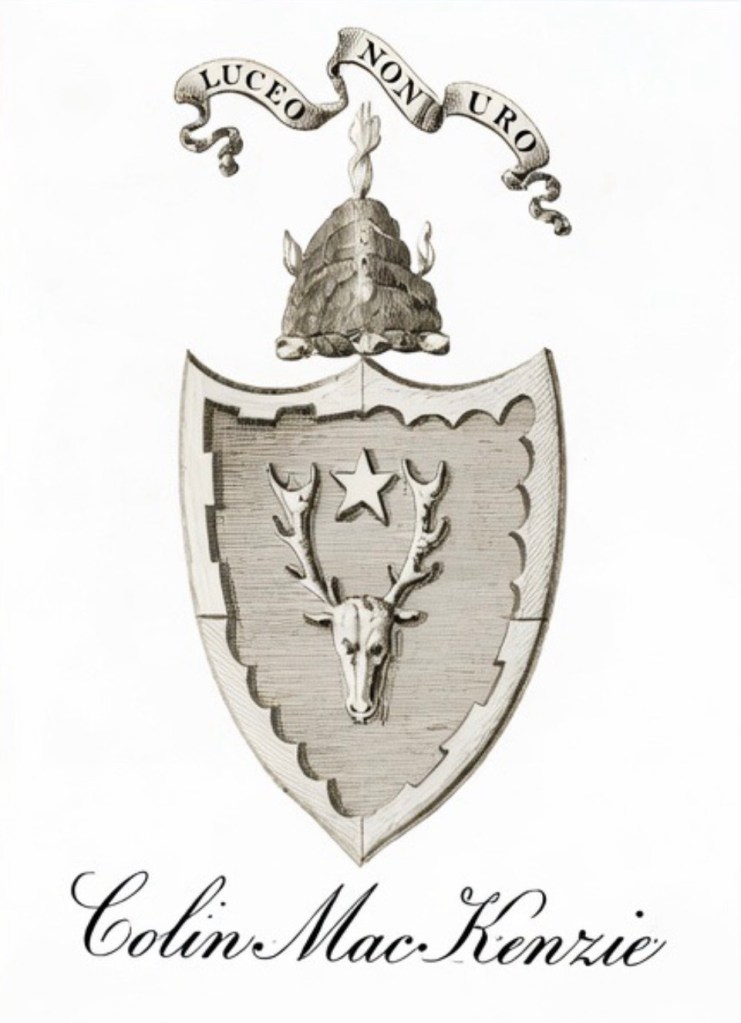
A recently highlighted example comes from a bookplate associated with Colonel Colin Mackenzie of Stornoway. The bookplate appears to display the familiar Mackenzie stag’s head with a star placed between the antlers, adding yet another example to the growing body of evidence that this feature was employed by Mackenzies long before modern heraldic debates arose.
Research shared by Kevin Paul McKenzie suggests that Colonel Colin was connected to the Fairburn branch of the family. The recorded arms of Fairburn are described as:
“Azure, a deer’s head cabossed Or, within a bordure embattled Argent.”
The crest is given as a mountain in flames, with the motto:
“Fide Parta, Fide Aucta”
(“Won by faith, increased by faith.”)
Kevin McKenzie has further suggested that Colonel Colin may have adopted the motto Luceo Non Uro (“I shine, not burn”), perhaps to complement the “mountain in flames” crest already associated with his branch of the family.
Colonel Colin also appears to have enjoyed close connections with the Seaforth family. In 1814, he played host to Mary Elizabeth Frederica Mackenzie, the daughter of Lord Seaforth Mackenzie and the wife of Admiral Sir Samuel Hood. She asked Colin to accompany her on a tour of India’s Upper Provinces in 1814, and Colin documented many of the monuments they saw, including the Sarnath Stupa and the Quwwat al Islam Mosque in Delhi. Readers interested in learning more about Lady Hood may enjoy Kevin McKenzie’s recommended article, “The Heart of Montrose.”
What makes the bookplate particularly interesting is that it provides yet another historical example of the star appearing alongside the Mackenzie stag’s head. Previous research has identified the star in sixteenth and seventeenth century heraldic manuscripts, seals, monuments, and cadet branch arms. The Colonel Colin bookplate now joins that growing list of evidence.
Whether employed as part of inherited arms or as a continuation of an older Mackenzie heraldic tradition, the presence of the star between the antlers cannot be dismissed as a modern innovation. Instead, it represents a feature deeply rooted in the heraldic history of Clan Mackenzie and one that appears repeatedly across several centuries of surviving evidence.
For further reading, see The Heart of Montrose