

Pietro Fabris, Kenneth Mackenzie, 1st Earl of Seaforth 1744 – 1781 at home in Naples
Kenneth Mackenzie, Viscount Fortrose and Earl of Seaforth (1744-1781) was the son of Kenneth Mackenzie, Viscount Fortrose, and his wife, Lady Mary Stewart, the daughter of Alexander Stewart, 6th Earl of Galloway and Lady Anne Keith. His paternal grandfather was William Dubh (or “Black”) Mackenzie, 5th Earl and 2nd Jacobite Marquis of Seaforth, whose titles and lands had been forfeited in 1716 following the Jacobite rising of the previous year. The “Old Register” of Saint Paul’s Church at Carruber’s Close in Edinburgh lists the congregation present at Kenneth’s baptism on 29 January 1744 and honours Lord Fortrose with his Jacobite title of “Marquis of Seaforth”, there being present several of the most prominent members of the Scottish aristocracy who were one year later to play a major rôle in the Jacobite cause. Kenneth’s father, however, backed the Government’s side in 1746; while his mother notoriously entertained Charles Edward Stuart at the family seat, Brahan Castle in Ross-shire, just prior to the Battle of Culloden.

Agostino Masucci, Kenneth Mackenzie, Viscount Lord Fortrose
Although the restored Seaforth estates of the Mackenzie Clan had been restored to Kenneth’s father in 1741, the Seaforth family’s rehabilitation in the 18th century was slow and faltering. Following the death of his father on 18 October, 1761, Kenneth did not appear to have paid much attention to his estates, spending more of his time in London or on the European Continent. As a boy he is known to have been in Naples with his father in the 1750s, and we know that he went on to travel extensively in Europe with his tutor, Dr James Mackenzie. The two of them were in Rome when Catharine Read painted them together in 1752, and the architects, Robert and James Adam later met them in Nice early in 1755, when Robert remarked that he had never seen “a little creature of more spirit, sense and sweetness than this little milord, as they call him, who speaks all languages with equal facility”.

Catharine Read, Kenneth Mackenzie, Viscount Fortrose and Dr James Mackenzie
During the period between 1764 and 1768, Kenneth was resident in England, and in 1766 he became a member of the Society of Dilettanti, appearing in one of the pair of Sir Joshua Reynolds’s group portraits of the Society, alongside his good friends, Sir William Hamilton, the naturalist, Sir Joseph Banks, and Sir Watkin Williams Wynn. These men shared a passion for music and theatricals as well as for art (Seaforth was known to have attempted to buy Raphael’s Madonna dell Sedia on one occasion). Members of the Society of Dilettanti all had a common experience of the Grand Tour. They lent their financial and powerful social support first to Italian opera and later to the discovery and publication of ancient art, architecture and the civilisations of Greece and Italy, as well as giving their patronage to young British artists. Seaforth also became a Fellow of the Society of Antiquaries and the progressive interests he shared with this enlightened circle accounts for his inclusion in a trip aboard the Admiralty yacht, Augusta,in June 1775, which he and Banks took in the company of the celebrated Omai, the first Tahitian to visit England.
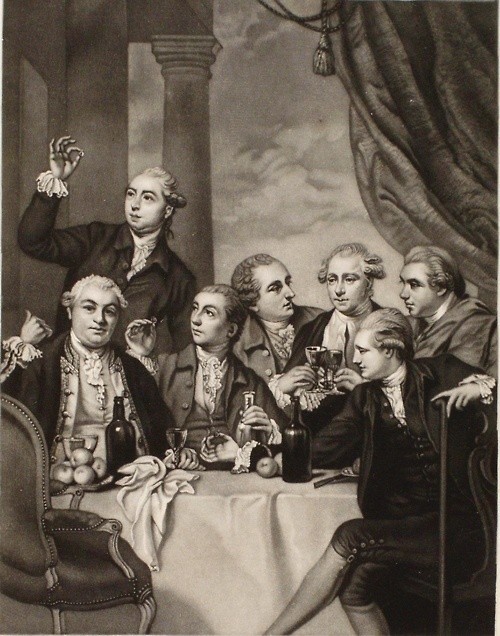
Sir Joshua Reynolds, The Society of Dilettante (Lord Seaforth 3rd from the right)
In his fellow Scot, Sir William Hamilton, the British Envoy to Naples, Fortrose found a particular kindred spirit and the two men formed a close and lasting friendship. They shared a passion for Roman antiquities and were among the first to realise the importance of the discoveries of Herculaneum and Pompeii. Both also had a love of music, as well as being active patrons of contemporary Neapolitan painters. On the 6th of November 1770, Lord Fortrose, as he then was, gave a “sumptuous musical feast” at his palazzo in the Via Chiaia in Naples for the visiting musicologist, Dr Charles Burney, who wrote of the occasion, “We went to Lord Fortrose, with whom we were to dine…It is impossible for anyone to do the honours of his house better than Lord Fortrose – we were all at our ease, all cheerful and happy.”
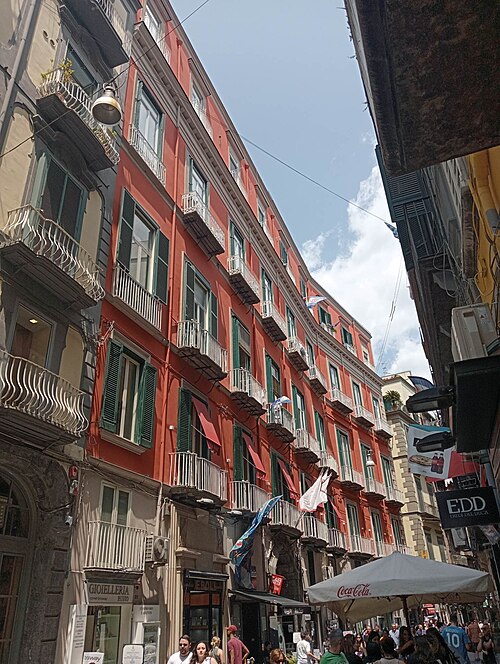
Lord Fortose’s residence in the Via Chiaia, Naples
A painting which Fortrose commissioned from Pietro Fabris, now in the National Portrait Gallery in Edinburgh, portrays just such a scene with a chamber concert in progress in Fortrose’s Neapolitan residence. The host, standing with his back to us, is listening to William Hamilton and the musician, Gaetano Pugnani, both playing the violin, while Leopold Mozart and his young son, Wolfgang, who visited Naples in May 1770, accompany the two gentlemen on the harpsichord.

Pietro Fabris, Kenneth Mackenzie, 1st Earl of Seaforth 1744 – 1781 at home in Naples
Fortrose’s protégé, the Neapolitan composer, Nicolo Jomelli, has been further identified as the man writing at the green-covered table in the companion painting.

Pietro Fabris, Kenneth Mackenzie, 1st Earl of Seaforth 1744 – 1781 at home in Naples, Fencing Scene
As well as being accomplished on the harpsichord and the violin, Fortrose was himself an amateur artist of some note, and gave paintings to several friends, including Hamilton, who noted A Rising Sun by Lord Fortrose on his list of paintings in the Palazzo Sessa. Charles Burney, who was asked to view Fortrose’s “collection of medals, cameos, intaglios, Etruscan vases, pictures etc.”, described his host as “a lively, sensible and accomplished young nobleman, – with a person very manly and pleasing; he has great talents and taste – He both draws and paints very well, understands perspective, rides, fences, dances, swims and plays the harpsichord.”

Thomas Patch, Kenneth Mackenzie, Viscount Fortrose
As well as his palazzo in the Via Chiaia, Lord Fortrose also rented a villa, once the casino of the Count of Friso and subsequently named the Villa Pavoncelli, just outside the centre of Naples, in Posilippo. Casini near to the shore at Posilippo, served mainly for sea-bathing when the court moved to this vicinity in summer, while also making it possible to keep an eye on the behaviour of Vesuvius at all times. And the scene we see in Fabris’s painting was described perfectly in May, 1770 by Patrick Brydone: “Sea-bathing”, Brydone wrote, “we have found to be the best antidote against the effects of the sirocco; and this we certainly enjoy in great perfection. Lord Fortrose, who is the soul of our colony here, has provided a large commodious boat for this purpose. We meet every morning at eight o’clock and row about half a mile out to sea, where we strip and plunge into the water … After bathing we have an English breakfast at his lordship’s, and after breakfast a delightful little concert, which lasts for an hour and a half.”

Pietro Fabris, A View of the Bay of Naples with the Villa Pavoncelli
Pietro Fabris, who appears to have become regarded as their friend and equal, accompanied Hamilton and Fortrose on a trip to Sicily in 1769, when he was commissioned to depict Fortrose in his carriage in the picturesque Piazza Vigliena (known as the Quattro Canti) in Palermo.
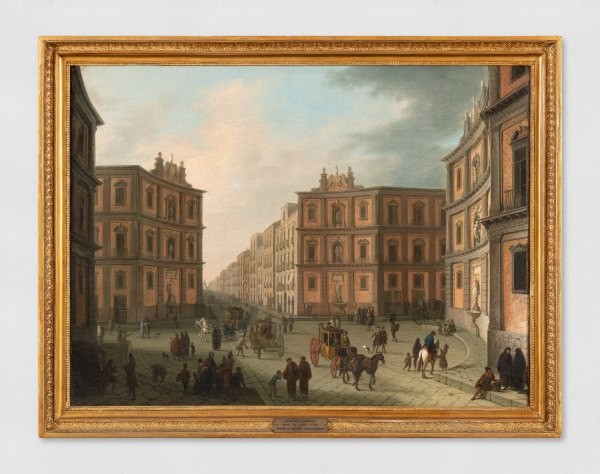
Pietro Fabris, Piazza Vigliena, Palermo, with Lord Fortrose in his carriage
On that trip, the three men made a groundbreaking ascent of Mount Etna. By calculating how long it would take for the vegetation to become established around Etna and Vesuvius – which they compared to ancient descriptions of the areas, as outlined in Hamilton’s Observations on Mount Vesuvius, Mount Etna, and other volcanos – theywere among the first to argue that the world had to be far older than the 6,000 years most then believed it to be. As a direct result of this and a mark of his contribution to the knowledge of his day, Seaforth was soon after elected as a Fellow of the Royal Society, later going on to sponsor the membership of his friend, Captain James Cook.

Pietro Fabris’s illustration of Etna in Sir William Hamilton’s Observations on Mount Vesuvius, Mount Etna, and other volcanos
It has to be said that Seaforth was less successful in his financial undertakings. While his more fertile Brahan estate in Easter Ross had been brought into good order, the extensive efforts on the part of his unpopular factor, George Gillanders, to improve his hitherto neglected Hebridean Lewis estate were obstructed by voluntary emigration and local opposition to a flax-spinning factory, that had been introduced “to assist the poorest people and keep them in temper and spirit”. As a consequence, in 1778 Seaforth was indebted to the sum of £74,000. A total annual income from his rents of about £4,000 was insufficient for him to meet both the interest on his debt and his cosmopolitan and dilettante lifestyle.
His main ambitions, however, were directed with the hope of securing the restoration of his family’s peerage. He was Member of Parliament for Caithness between 1768 and 1774, being listed on the few occasions that he attended the Commons as a friend of the Government, although he appeared to have little inclination to represent his family’s traditional interest in Ross-shire in the House of Commons. The acquisition from the Duke of Grafton (1st Lord of the Treasury and soon to become Prime Minister), in November 1766, of the Irish Viscountcy of Fortrose – which was raised to the Irish Earldom of Seaforth on Grafton’s rejoining the Government in 1771 – owed more to the fact that in 1765 he married Lady Caroline Stanhope, the daughter of the Earl of Harrington and the Duke of Grafton’s first cousin. It was above all his social connections that achieved his ambition.
Another significant moment in Seaforth’s ambition to restore his family’s fortunes came when he returned to Scotland briefly in 1777 to take the opportunity of proving his loyalty to the Government by raising a regiment, the 72ndRegiment of Foot, when the British Army needed new troops for the American War of Independence. This was a body of 1,130 men, principally from Wester Ross, in which the officers were largely gentlemen of his own name. Five hundred men were enlisted among his immediate vassals, and about four hundred from the estates of the MacKenzies of Scatwell, Kilcoy, Redcastle, and Applecross, including a considerable number of men who were dubbed “Wild MacRaes” from the west coast. This regiment, which was to make a proud and significant contribution to British military history over the years to come, came to be known as the Seaforth Highlanders.

But sadly, Seaforth was not to reap any material rewards for his loyal endeavours during his own lifetime. His lifestyle, which, to be fair, had brought him social status, forced him into debt, leading him to sell the Seaforth Estate in January 1781 to his cousin, Thomas MacKenzie-Humberston, for £100,000 sterling. It was perhaps of greater importance to the Earl, however, that this transaction enabled him both to marry his longstanding mistress, Harriet Powell, and to provide for her future. Harriet was an apothecary’s daughter, publicly his mistress and privately his wife, who had her portrait painted by Sir Joshua Reynolds and Catharine Read. Seaforth had taken up with Harriet following Caroline’s death and by the summer of 1773, she was established in one of the Adam brother’s fashionable houses in the Adelphi, the new neoclassical development on the Thames. At that time to keep a courtesan was common and accepted behaviour amongst the aristocracy, but to live with her was a rarity, let alone to go on to marry her in an age when marriage among his class was most often for social, political or economic advantage.
Harriet’s celebrity, however, could never provide the status that his first wife had. Indeed, the union was hushed up by the family, evidently with great effect, as is testified by a letter that the last Lord Seaforth’s grandson wrote more than half a century later: Keith Stewart-MacKenzie was to assert that “there was no Lady Seaforth of the name of Powell and certainly none who was an actress.”
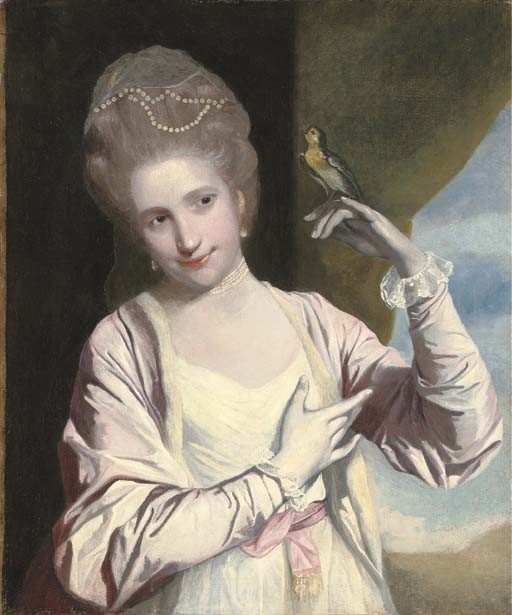
Sir Joshua Reynolds, Harriet Powell as Leonora in The Padlock
Besides her outstanding beauty, Harriet was described as having “uncommon good sense, vivacity and judgement”, together with a “delicacy of sentiment”. Even the usually cynical Town and Country magazine celebrated the true warmth of the couple’s relationship when it wrote that Seaforth “took every occasion to testify his regard and esteem for her…Her taste in dress and character were manifested at every masquerade, in which she was imitated by women of the first fashion, who at once envied Harriet her lover, and those charms that had so completely captivated him. In fine, they are perhaps the happiest couple out of the pale of matrimony, within the hills of mortality: and this alliance, which appears to have a very permanent basis, may be cited as one that does the least scandal to morality in the whole cycle of polite gallantry.”
The hoped-for future for this couple that the sale of the Seaforth Estates was intended to bring, however, was to be tragically short-lived. For, Seaforth’s military endeavours were soon hit with fraught difficulties. Despite an initial undertaking that the Seaforth Highlanders were only to be employed defending the Channel Islands from America’s French allies, rumours reached the men that they were to be sent to the distant and disease-ridden sub-continent of India. When next pay was not forthcoming (most likely the fault of London as much as of the officers), the men mutinied and set up camp on Arthur’s Seat in Edinburgh.
There they were supplied food by the sympathetic townsfolk. There was even a false claim in the newspapers that Seaforth begged his men for his life, and his relationship with them certainly reached a low point during the dispute. But after three days a compromise was agreed with the Government, whereby Seaforth promised his men that he would accompany them in person wherever they were sent, and this was reported to have been met by cheers. In the end, this noble promise on his part was to prove fatal.
After he and Harriet accompanied the regiment to their first posting in Guernsey, Harriet tragically died when returning on a packet boat to Southampton in December, 1789, probably still in her 20s. We then find a devastated Seaforth turning increasingly to the bottle.

Catharine Read, Harriet Powell (mezzotint)
It was next announced that the regiment was to be posted to Madras in India as had been feared, a trip that everyone expected to be one-way. Thus, Seaforth honoured his promise to his men that he would accompany them, abandoning his once comfortable and glittering lifestyle to encounter, in the words of one contemporary chronicler, “the privations and inconveniences of a long voyage,” and “the dangers and fatigues of military service in a tropical climate”.
After sailing for two months, just before reaching the island of St Helena in the mid-Atlantic, scurvy broke out on board the ship and, aged only thirty-seven, Seaforth succumbed to the disease. He was buried by his now devoted men at sea. A letter between his good friends, Sir Joseph Banks and Sir William Hamilton, dated 13 February 1782, stated: “Poor Seaforth you read by the papers is dead. He went off suddenly and was drunk when he died. It would have been extraordinarily lucky if he had been sober as it was for some time his custom to keep a regular fire of drams day and night whenever he was awake.”
The East India Company reported his death as follows: “A warm zeal for his country’s service was distinguishable in the late Earl of Seaforth in the Act of raising soldiers for the Army. An happy Talent for promoting the reciprocal Interests of his Sovereign and the People, was invigorated by a very liberal Spirit which strongly recommended him to the people’s Esteem … This Country has sustained a considerable Loss in the Death of his Lordship, who was an enterprising and brave Officer.” The magazine, Town and Country wrote the following epitaph for the last Earl of Seaforth: “The time may, probably, come when lord S- will … eclipse many who are esteemed the first-rate planets of learning and intelligence: in the meantime, he will, most likely, indulge the bent of his disposition, and blend the philosophy of reason with the gallantry and gaiety of the polite world.” Indeed, in summing up Kenneth Mackenzie’s achievements, it should be pointed out that his foremost interests were neither political, nor financial: it was his intellect and sociability that allowed him the full and complete integration into British Society that his ancestors had so long craved.
Kenneth left a single daughter by his first wife, Lady Caroline Mackenzie (1766-1847). As we have seen, his estates had already been sold to his cousin, Thomas Mackenzie Humberston, who also went on to inherit the chiefship of Clan Mackenzie.

Thomas Patch, Kenneth Mackenzie, Viscount Fortrose
All images are in the public domain, licensed either under the Creative Commons Attribution-Share Alike 4.0 International licence, or specifically licensed to the author.
