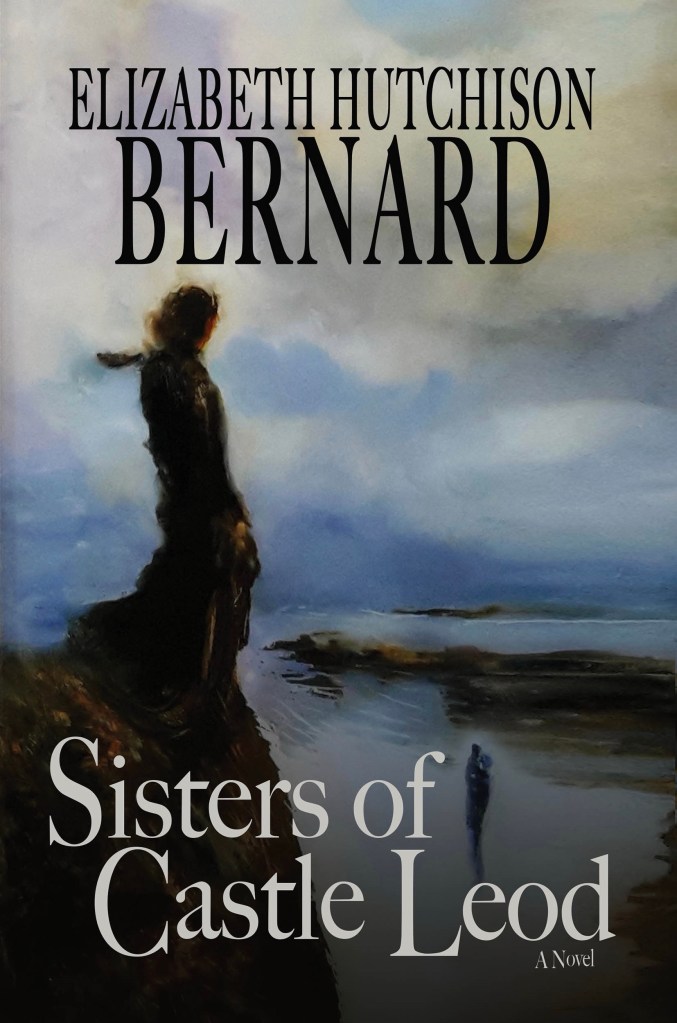
THE MACKENZIE SISTERS, SIBELL AND CONSTANCE
As an author of historical fiction, I am always on the lookout for people from the past whose extraordinary personalities, exploits, and achievements have power to stir the imagination. I found two such inspiring women when I discovered Countess Sibell Lilian Mackenzie (1878- 1962) and her younger sister Lady Constance (aka Constance Stewart-Richardson, Constance Matthew, 1883-1932) They are the amazing Mackenzie women of my historical novel Sisters of Castle Leod.
Sibell and Constance grew up in the late Victorian era, residing off-and-on in the iconic Castle Leod. The sisters could not have been more opposite in looks, temperament, or interests. As a young girl, Sibell was quiet and shy, with a love for books and wandering over the moors with her beloved dog as her sole companion. While still in her 20s, she began her career as an author of short stories and mystical romance novels that achieved great popularity in the Edwardian era. Throughout her life, she witnessed ghosts and experienced psychic events. She came to believe in reincarnation and claimed to have a Phoenician spirit guide.
Lady Constance achieved early fame as a competitive swimmer, winning several gold medals from London’s prestigious Bath Club. She was highly proficient in fencing and shooting, and later excelled at big game hunting in India and Africa. Her book entitled Dancing, Beauty and Games (Arthur L. Humphreys, 1913) promotes an ideology stressing the pursuit of physical and mental health through exercise, purity of thought, and return to a “natural” way of life. As an Isadora Duncan-style barefoot dancer, touring the public theaters of Europe and America, Constance became a controversial figure, earning the disapproval of King Edward VII who, in January 1910, took the extreme measure of banishing her from court society.
Summing up the differences between the sisters, one journalist of the day wrote:
“Lady Cromartie has always been an idealist, and Lady Constance a materialist. While the Countess was given to . . . lying in a hammock, puzzling over the riddle of the universe . . . Lady Constance was hunting, shooting, fishing, or skating.” (Victoria Daily Colonist, Victoria, British Columbia, CA, 1913)
THE COUNTESS
Lady Sibell Lilian Mackenzie became the 3rd Countess of Cromartie while still in her teens. Her father, Francis Mackenzie Sutherland-Leveson-Gower, 2nd Earl of Cromartie, died in 1893, having no sons but two daughters. Sibell, the eldest, inherited his titles and estates including Castle Leod in the picturesque Highland village of Strathpeffer. Young Sibell had the good fortune to be a peeress in her own right, meaning that her titles were acquired by inheritance rather than marriage. How this came about is complicated. The Cromartie titles were originally created in the Peerage of Scotland but forfeited due to George Mackenzie’s support of the Jacobite rebellion in 1745. A hundred years later, they were recreated in the peerage of the United Kingdom, in which the passage of titles to female heirs was forbidden. However, with the recreation of the Cromartie titles by Queen Victoria, a special remainder was added allowing them to pass to a female heir, consistent with Scottish law. This exception was made in recognition of Victoria’s close friendship with Sibell’s grandmother, Anne Hay-Mackenzie, who became Duchess of Sutherland and served as the queen’s Mistress of the Robes.

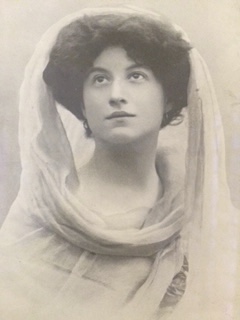
I knew nothing of Countess Sibell Mackenzie when I undertook a brief study of spiritualism in the Victorian and Edwardian eras. In reading an excellent book by Janet Oppenehim, The Other World: Spiritualism and Psychical Research in England, 1850-1914 (Cambridge University Press, 1985), I was intrigued by the diversity in backgrounds among individuals of that era who attended seances and studied psychic phenomena; believers included artists, intellectuals, self- educated workers, doctors, clergymen, professors, and many aristocrats. Why the widespread openness towards spiritualism and psychic experiments at this particular period in history? As Oppenheim explains, the rapid rise of scientific research was increasingly perceived as a threat to religion; “proving” the reality of supernatural events offered the possibility of a bridge between science and faith.
A memoir written by the Scottish author, poet, and spiritualist Violet Tweedale (Ghosts I Have Seen and Other Psychic Experiences, Frederick A. Stokes Company, 1919) provided my first introduction to the 3rd Countess of Cromartie. In her book, Tweedale relates several other- worldly incidents that occurred during her visits to Tarbat House, Sibell’s three-story stone mansion near Invergordon. Tweedale wrote:
“. . . Lady Cromartie is a mystic of no ordinary type, but only those who know her intimately are aware of how predominating in her character is this inborn mysticism . . . In the afternoon, when we were out walking, Lady Cromartie said suddenly to me and a Miss Drummond, whom we were both very fond of, ‘There is going to be an earthquake tonight.’ . . . We asked Lady Cromartie how she could possibly tell that an earthquake was coming. Such convulsions are not common enough in Scotland to admit of lucky guesses. ‘I can tell those things of Nature; something in me is akin to them,’ she explained . . . At one o’clock in the morning, when we were all asleep, the earthquake arrived, and awakened us all instantly . . . In the morning we heard that considerable damage had been done.”


that once was Sibell Mackenzie’s favorite home.
I tell a similar version of this story of the earthquake in my novel Sisters of Castle Leod. I also relate, in a fictional context, several instances in which Sibell encounters the ghost of Castle Leod, fondly called the Night Watchman. My knowledge of the Night Watchman came not from Violet Tweedale but directly from the 5th Earl of Cromartie, John Mackenzie, who is Sibell’s grandson. In 2019, I visited the castle and had the pleasure of a guided tour by the very gracious chief of Clan Mackenzie. He told me that he has seen the Night Watchman many times, wearing armor and carrying a lit lantern as he roams the castle.
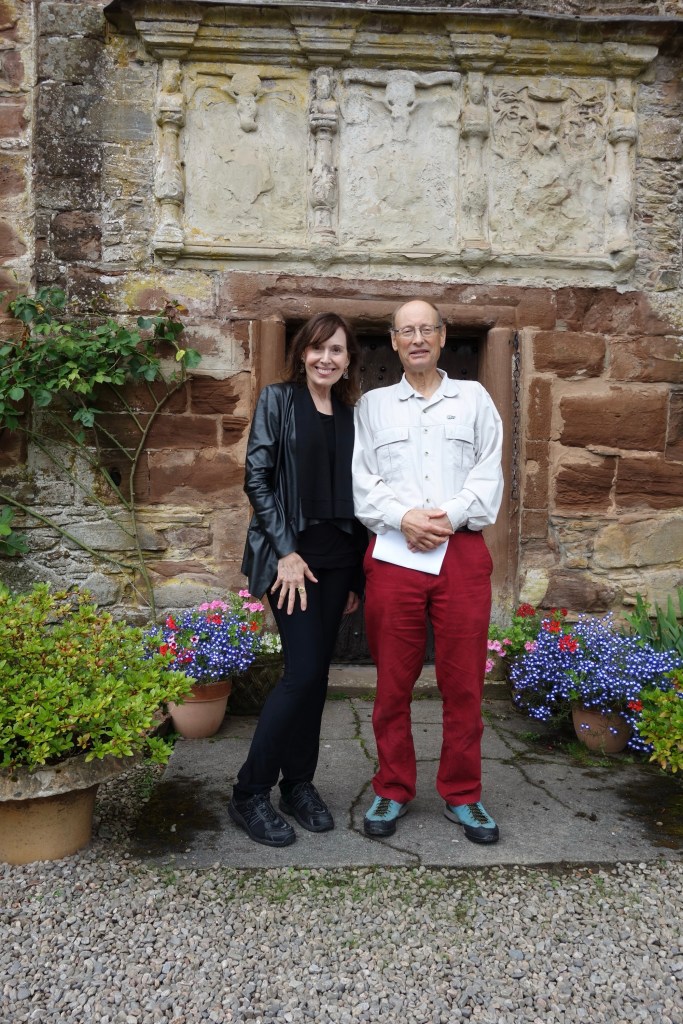
John Mackenzie, 5th Earl of Cromartie (2019)
Sibell was a prolific author, penning many short stories that were published in the popular British women’s magazine The Lady’s Realm as well as newspapers across the UK and America. Her novels generally were set in antiquity and often reflected her fascination with the ancient civilization of the Phoenicians. Some scholars have pointed to linguistic, geographic, religious and historic links between Phoenicians and the Celtic Irish. Sibell was aware of such claims and no doubt eagerly embraced them.
Much of what I discovered about Sibell during the two years of researching and writing my book came from newspaper articles of the era. (source: NewspaperArchives.com). While such resources always bear the taint of journalistic bias and may contain numerous inaccuracies, they serve as a valuable lens into events of the day and attitudes of society at large. A good example is this excerpt from an article describing Sibell’s “coming out,” or first introduction at court, at which Queen Victoria herself presided:
“Nowadays you observe that the run of debutantes presented consists of every upstart whose family has rigged up for itself a compound surname. For every two-penny-half-penny nobody who has made a little money in trade to fancy he confers a sort of patent of nobility upon himself and his offspring by inserting a hyphen between his surname and his middle name is simply grotesque. But instead of these nobodies with whom recent drawing-rooms have reeked, there were no end of real swells at this one. The most interesting of all the presentations was that of the youthful Sibell Mackenzie Leveson-Gower, Countess of Cromartie.” (Gympie Times and Mary River Mining Gazette, Gympie, Queensland, AU, 1897)
In the archives, I found many helpful references to Sibell’s appearance and character, most often flattering but occasionally with a subtle barb:
“Lady Cromartie is very pretty, small and dark, with perfect features, fine eyes, and a bright, animated manner. She is far less strenuous and athletic than her more enterprising sister, and leads a quiet life . . .” (London Mainly About People, 1905)
“Lady Cromartie is one of our Society women writers, and has produced poems, stories, and articles descriptive of Highland life or dealing with matters mysterious. In fact, she takes deep interest in all things occult, and when in London attends lectures on the subject. Mauve is her favorite color but she seems somewhat indifferent to dressmakers.” (London Mainly About People, 1906)
Newspaper accounts helped me to piece together where the sisters went and when, as well as other details of their lives. Still, there is nothing quite so wonderful as gaining insights into a person’s character from reading their own words. While unable to obtain records of personal correspondence, I was able to find many of Sibell’s stories in archives of The Lady’s Realm. I was also fortunate to locate several First Edition copies of Sibell’s novels, all of which are out of print. Her writing, while flowery in the manner of that period, is evocative and her storytelling quite skilled. Newspaper reviews of her work were mostly positive, though some suggested that she was not properly “Christian” in her choice of heroes. The following excerpt, from one of my favorite reviews, takes the opposite view:
“It is seldom one can find a woman who describes men with the strength and clean, clear understanding Lady Cromartie possesses. They are all Pagans, perhaps, but one wishes Christianity of today could show us such fine, wholesome specimens of manhood. Lady Cromartie has opened in this novel a new page of romance. One almost fancies she must possess the gift of ‘seeing,’ so vivid are her pen pictures, so true and sure and vibrating with life her people.” (from a London Evening News review of Sons of the Milesians, 1907)
THE BAREFOOT DANCER
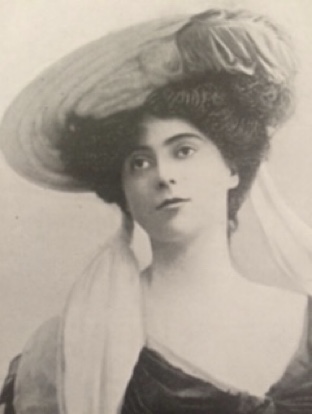

Sibell’s younger sister, Lady Constance, was even more the focus of press attention than the countess. While Sibell’s sense of duty was an overriding force in her life, Constance was a committed free spirit. Evidence strongly suggests that the sisters were estranged for much of their adulthood. For example, neither Sibell, nor any family members, were invited to Constance’s wedding in 1904; in fact, Sibell knew nothing of Constance’s intention to wed Sir Edward Austin Stewart-Richardson (1872-1914), believing she was still engaged to Captain Percy Fitzgerald. Perhaps adding insult to injury, the wedding reception was held at Tarbat House while Sibell was away. (For the purpose of my novel, I move the location of the reception to Castle Leod.)
What was the cause of the sisters’ long estrangement? Sibell’s extraordinary wealth was likely one reason. Her inheritance made her one of the richest landowners in Scotland. Though Constance received a sizeable bequest of twenty-seven thousand pounds sterling, it could not support her lifestyle indefinitely. In 1913, she was quoted in a newspaper interview claiming both she and her husband were “stony broke.” Another reason for the sisters’ separation was Constance’s unorthodox behavior, especially her barefoot dancing in public theaters, which was an embarrassment to Sibell. Imagine her reading this description of her sister’s first public performance in London:
“Her exhibition tonight was the most daring display that London has seen, and it has witnessed dances by Maud Allan, Isadora Duncan, Gertrude Hoffman and many others of the so-called Greek dancers. It was given at Alfred Bett’s Palace music hall, where Lady Constance received a salary of about $1,000 a week . . . When she appeared on the stage, the audience sat up and gasped. She wore a ‘filmy’ drapery, practically transparent. Her costume was such that it would not have been tolerated if worn by a professional dancer, but worn by a woman of title nothing was done.” (The San Francisco Call, 1910)
Perhaps all this is enough to explain the division and discord between the sisters. Being a writer of fiction, however, I was looking for an even more compelling wedge between them—something with a hint of the supernatural. Then I made a stunning discovery in the newspaper archives:
“Lady Constance Mackenzie is sister and heir presumptive to the Countess of Cromartie, who also holds the titles Viscountess Tarbat, Baroness Castlehaven, and Baroness MacLeod. Lady Constance’s succession to all these titles, as well as the large family estates, depends upon the fulfillment of an old family legend whose truth in part has been demonstrated already, in a manner to arouse the awe of the superstitious, by a family tragedy that occurred last December. The Countess of Cromartie suffered the loss of her only child, a baby girl, who died when she was less than a month old. The death of the baby heir was in accordance with the legend which declared when a certain stream on the estates should be turned from its course, the succession would pass from the direct line. Only a few weeks before the child’s death, in making alterations on the estates, the course of the stream had been changed. Unless other children are born to the Countess of Cromartie, Lady Constance will succeed her.” (Sydney Evening News, Sydney, New South Wales, AU, 1902)
This little article was, for me, an “a-ha!” moment. I knew from my research that Constance, prior to any plans for marriage, had purchased from Sibell an old farmhouse on the estates. What if Constance had arranged for the course of the stream to be altered so it ran closer to the farmhouse—either forgetting about the legend or dismissing it as just an old superstition? And what if Sibell, being on the superstitious side, found out about what had been done and blamed her sister for her baby’s sudden death?
If you are a lover of pure biography, perhaps you cannot find it in your heart to forgive the workings of a fiction-writer’s imagination. In my book’s Author’s Note, I clarify that this element of the novel’s plot—that Constance was responsible for changing the course of the stream—is only speculative and not based on any known facts. Let me offer, too, the following quote from one of the world’s best-loved writers of historical fiction, Dame Hilary Mantel, author of the classic Wolf Hall, who argues for the right of artistic license on the part of historical fiction authors: “As soon as we die, we enter fiction. Just ask two different family members to tell you about someone recently gone, and you’ll see what I mean. Once we can no longer speak for ourselves, we are interpreted.”
It may be wishful thinking, or an overactive imagination … but I feel as if Sibell came to see me one night to present her case for telling the sisters’ story from her point of view. I woke up around two in the morning to see what appeared as a figure in a hooded red cape hovering a short distance from my bed. Not being accustomed to ghostly visitations, I decided it was just a trick of shadow and light. But I watched it for a couple of minutes to see if it would change or disappear; since it did neither, I became weary and soon fell back to sleep. The next day, I began reading one of Sibell’s novels and, in the very first chapter, the female protagonist dons a hooded scarlet cape. I had never opened this book before, and I couldn’t help thinking that my vision of the previous night might be more than a coincidence.
I went on to write Sisters of Castle Leod with Sibell as the book’s narrator, and I’m happy that I made that choice. However, in the course of my research and writing, I developed great affection and admiration for both sisters. As Sibell says, in the novel, “Constance loved to challenge nature. I preferred to cherish it. Yet, accustomed as I was to thinking we were opposites, I wondered whether perhaps we really weren’t. Each of us, in our way, was an explorer. She in the wild places of the earth, and I in whatever lies beyond.” This is how I think of the Mackenzie sisters . . . and what I love about them.
Sisters of Castle Leod, by Elizabeth Hutchison Bernard, is an Editors’ Choice of the Historical Novel Society and Book 1 of the series Historic Women of the Highlands.
To learn more, visit www.ehbernard.com.